

Table of Contents
- What You'll Need Before Starting Your Custom Apparel Design
- Step 1: Define Your Custom Apparel Design Vision
- Step 2: Understand Custom T-Shirt Design Options
- Step 3: Choose Between Screen Printing vs. Embroidery
- Step 4: Prepare Your Artwork Files for Apparel Printing
- Step 5: Navigate Custom Apparel Pricing and Get a Quote
- Common Mistakes to Avoid When Ordering Custom Apparel
- Frequently Asked Questions
Last Updated: October 11, 2026
What You'll Need Before Starting Your Custom Apparel Design
Creating custom apparel design requires the right preparation, tools, and understanding. At Wild Doe Tee Co, we've guided customers through this process, the ones who succeed start with clarity.
Before ordering, gather: a clear vision, artwork or design concept, sizing information, a realistic budget, and your preferred printing method.
Jumping straight to ordering without planning leads to prints that crack, poor fit, or designs that don't translate to fabric. Planning upfront saves frustration and money.
| What You'll Need | Why It Matters |
|---|---|
| Clear design vision | Prevents costly revisions and delays |
| Artwork files or concept | Enables accurate quotes and production |
| Size and quantity information | Ensures correct order fulfillment |
| Budget range | Helps set realistic expectations |
| Printing method preference | Affects durability, cost, and appearance |
Step 1: Define Your Custom Apparel Design Vision
Your vision is the foundation. Ask yourself: Are you creating matching shirts for an event, branded apparel for a team or business, or a personal statement piece?

Write down specific details: colors, text or images, one-time event or regular wear. Specificity now simplifies the rest of the process.
Consider your audience and occasion. Casual gatherings allow bolder designs than corporate branding or gifts for others.
Step 2: Understand Custom T-Shirt Design Options
Custom T-shirt design options range from simple text to complex multi-color artwork, each affecting the final result.
Text designs work for team names and dates. Logo designs brand apparel with your mark or symbol. Photo designs depend on original resolution and printing method.
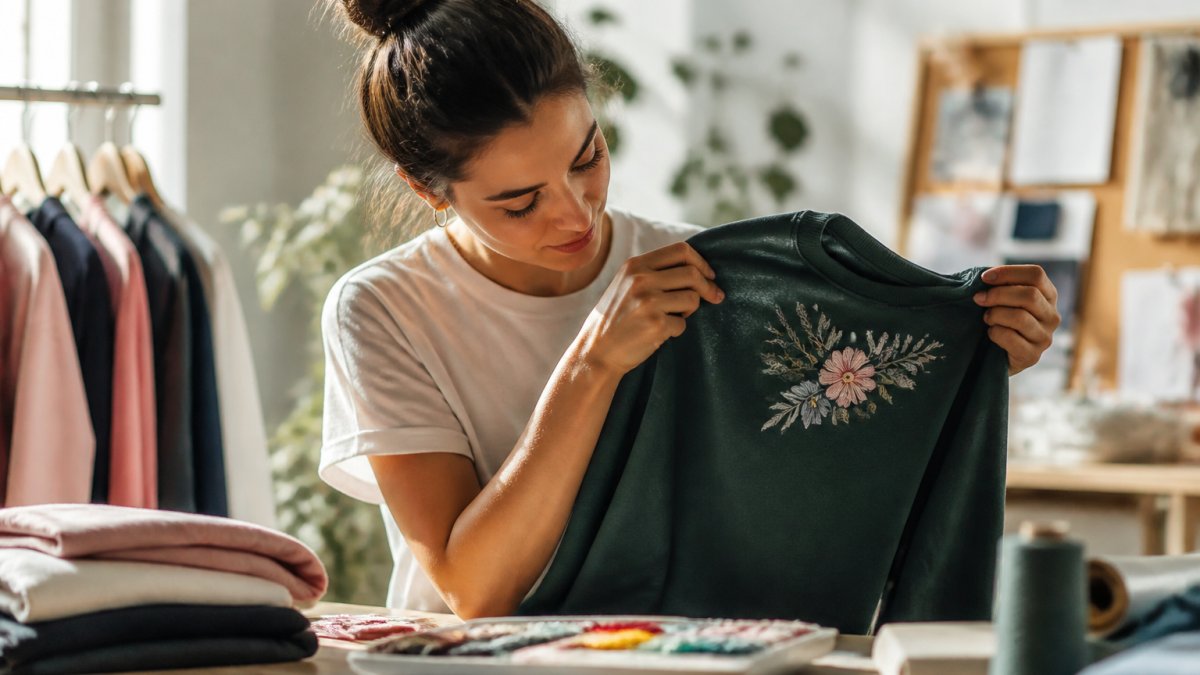
Consider whether your design works across multiple garment colors. A white design disappears on white; fine details may need adjustment for different shades.
Step 3: Choose Between Screen Printing vs. Embroidery
Your decoration method determines appearance, durability, cost, and speed.
Screen Printing
Embroidery
Embroidery stitches designs into fabric, creating a premium, three-dimensional look. It works beautifully for logos and clean-line designs, surviving hundreds of washes without fading, peeling, or cracking.
Trade-offs: higher per-unit cost, longer production, poor results on photo-realistic or color-heavy designs. Stretchy fabrics can pucker.
Embroidery is best for professional branding, corporate apparel, or personal items you want to last. The upfront cost is higher, but durability justifies the investment for long-term wear.
Direct-to-Garment (DTG) Printing
DTG prints designs directly onto fabric using inkjet printers. It excels at photo-realistic designs and fine details with no setup fees, making it economical for small orders.
Trade-offs: works best on cotton; polyester doesn't accept ink reliably. Colors are softer than screen printing, durability is moderate (30-50 washes), and it's slower for large orders.
DTG is ideal for photo prints, detailed artwork, small orders, and designs with many colors. It's less suitable for apparel that will be washed frequently or needs to last years.
Direct-to-Film (DTF) Printing
DTF combines screen printing and DTG advantages. The design is printed onto film, then heat-pressed onto the garment. It works on any fabric and produces vibrant prints without setup fees.
Trade-offs: more expensive than screen printing for large orders, but cheaper than DTG for small orders. Durability is very good (50-100+ washes) but less proven. Not all providers offer it yet.
DTF is ideal for small-to-medium orders (5-100 units), detailed designs, and apparel in any fabric type. It's becoming increasingly popular as an alternative to screen printing for orders too small to justify setup fees.
Decision Framework: Which Method Should You Choose?
| Factor | Screen Printing | Embroidery | DTG | DTF |
|---|---|---|---|---|
| Best for | Bold graphics, solid colors, large orders | Logos, professional branding, durability | Photo-realistic, detailed, small orders | Detailed designs, any fabric, small-medium orders |
| Setup cost | $25-$75 per color | Minimal | None | None |
| Per-unit cost (50+ units) | $1-$3 | $5-$15 | $8-$12 | $4-$8 |
| Per-unit cost (1-10 units) | $15-$30+ | $8-$20 | $8-$12 | $6-$10 |
| Durability | Excellent (50-100+ washes) | Excellent (100+ washes) | Moderate (30-50 washes) | Very good (50-100+ washes) |
| Works on polyester | Yes | Limited | No | Yes |
| Best for photos | No | No | Yes | Yes |
| Turnaround | 7-14 days | 10-21 days | 3-7 days | 5-10 days |
How to Choose
Start with design type. Simple logos or bold graphics: embroidery.
For frequent wear and years of use, invest in embroidery.
Sweatshirt or Teeshirt - Lash Boss →
Step 4: Prepare Your Artwork Files for Apparel Printing
Your artwork files determine print quality. File preparation is straightforward once you understand the basics.
Save artwork at 300 DPI minimum. Low-resolution web images (72 DPI) pixelate when enlarged. Request vector files if available, they scale perfectly without quality loss.
Use PDF, EPS, or high-resolution JPG. Avoid Word or PowerPoint files. Export final artwork, not editable project files.
Printers need CMYK color mode, not RGB. Conversion can shift colors, so communicate exact color preferences to your printer.
Step 5: Navigate Custom Apparel Pricing and Get a Quote
Custom apparel pricing depends on garment type, quantity, printing method, design complexity, print locations, color count, setup fees, and rush timelines. Knowing what to ask for puts you in control.
Garment Base Cost
Printing or Embroidery Setup and Per-Unit Charges
Print Location and Design Size
Chest print is standard.
Color Count (Screen Printing)
Each color adds setup cost. A 1-color design costs $25; a 4-color design costs $100. For 500 shirts, that's $0.15 per shirt; for 10 shirts, it's $7.50 per shirt. Large orders make multi-color designs economical.
Rush and Turnaround
Getting an Accurate Quote
When you contact a provider, provide these specifics to get a real quote:
- Garment type and brand (e.g., "Gildan 5000 t-shirt, heather gray")
- Quantity (e.g., "50 shirts")
- Printing method (screen printing, embroidery, DTG, or DTF)
- Design details (number of colors, size, placement, complexity)
- Desired turnaround (standard or rush)
- Any special requests (samples, proofs, specific pantone colors)
Comparing Price vs. Quality
Common Mistakes to Avoid When Ordering Custom Apparel
Most problems with custom apparel orders stem from preventable mistakes made during planning or preparation. Knowing what goes wrong helps you avoid the same pitfalls.
Underestimating turnaround time causes stress and missed deadlines. Custom apparel isn't instant.
Assuming one design works for all garment colors leads to disappointment. A white design on a white shirt disappears. Neon colors look different on black versus light gray. Always request a proof showing your design on your chosen garment color before final production.
Skipping the proof stage is tempting but risky. A proof shows exactly how your design will look on the actual garment. Catching errors at the proof stage costs nothing; fixing mistakes after production is expensive or impossible.
Ordering incorrect sizes without verifying measurements creates returns and exchanges. Sizing varies between brands and styles. Check the specific size chart for the garment you're ordering, and when ordering for a group, collect accurate measurements from everyone.
Creating custom apparel design that you'll actually love wearing requires planning, but the process is straightforward once you understand the steps. From defining your vision through preparing files and choosing your printing method, each stage builds toward a final product that reflects your style.
Wild Doe Tee Co specializes in bringing your creative ideas to life with personalized apparel that captures individual style. Whether you're designing for a special event, building branded merchandise, or creating a gift that feels truly personal, our custom creation services ensure you get exactly what you envision. Start your custom apparel design journey with a clear plan, quality artwork, and the right printing method for your needs, then let our team handle the rest. Shop custom apparel at Wild Doe Tee Co and create something uniquely yours.
Frequently Asked Questions
What artwork file should I provide for custom apparel printing?
Provide a high-resolution file (at least 300 DPI) in vector format like AI, EPS, or PDF for best results. If you only have a raster image (JPG or PNG), ensure it's at least 1200 x 1200 pixels. Include your logo or design centered, with clear separation between design elements. Ask your provider about file specifications before uploading, embroidery files differ from screen printing files. Wild Doe Tee Co guides you through the process and can help refine designs that aren't quite ready yet.
How much does custom apparel pricing typically cost?
Custom apparel pricing depends on the garment quality and order size. Embroidered sweatshirts at Wild Doe Tee Co start at $38, while custom logo tees begin at $30. Embroidery suits smaller batches.
How do I choose between screen printing, embroidery, and direct-to-garment printing?
Embroidery creates a premium, textured look perfect for logos and smaller orders, Wild Doe Tee Co's embroidered pieces prevent fading or peeling. Consider your design complexity, order size, and budget. Embroidery is ideal for personalized gifts.
What should I ask a local custom apparel designer before placing an order?
Wild Doe Tee Co provides clear timelines, 1-3 days production plus 2-3 business days shipping.